Trustpilot
2025, 2026
AI assisted custom dashboards
Trustpilot is a global reviews platform that helps people and businesses build trust. While most people know Trustpilot for its consumer-facing review site, there’s a robust B2B product behind the scenes designed to help businesses collect, analyse, and act on their review data.
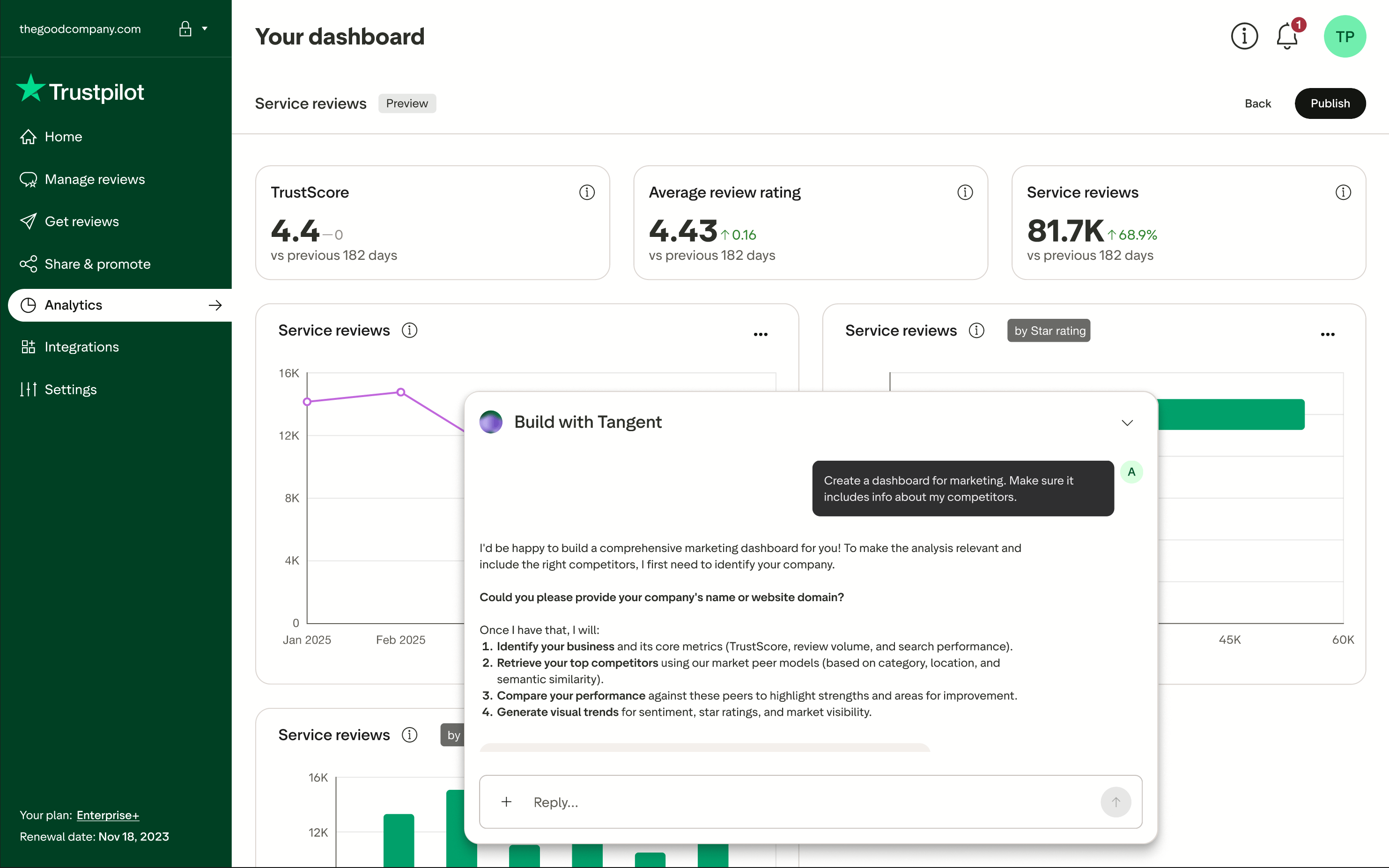
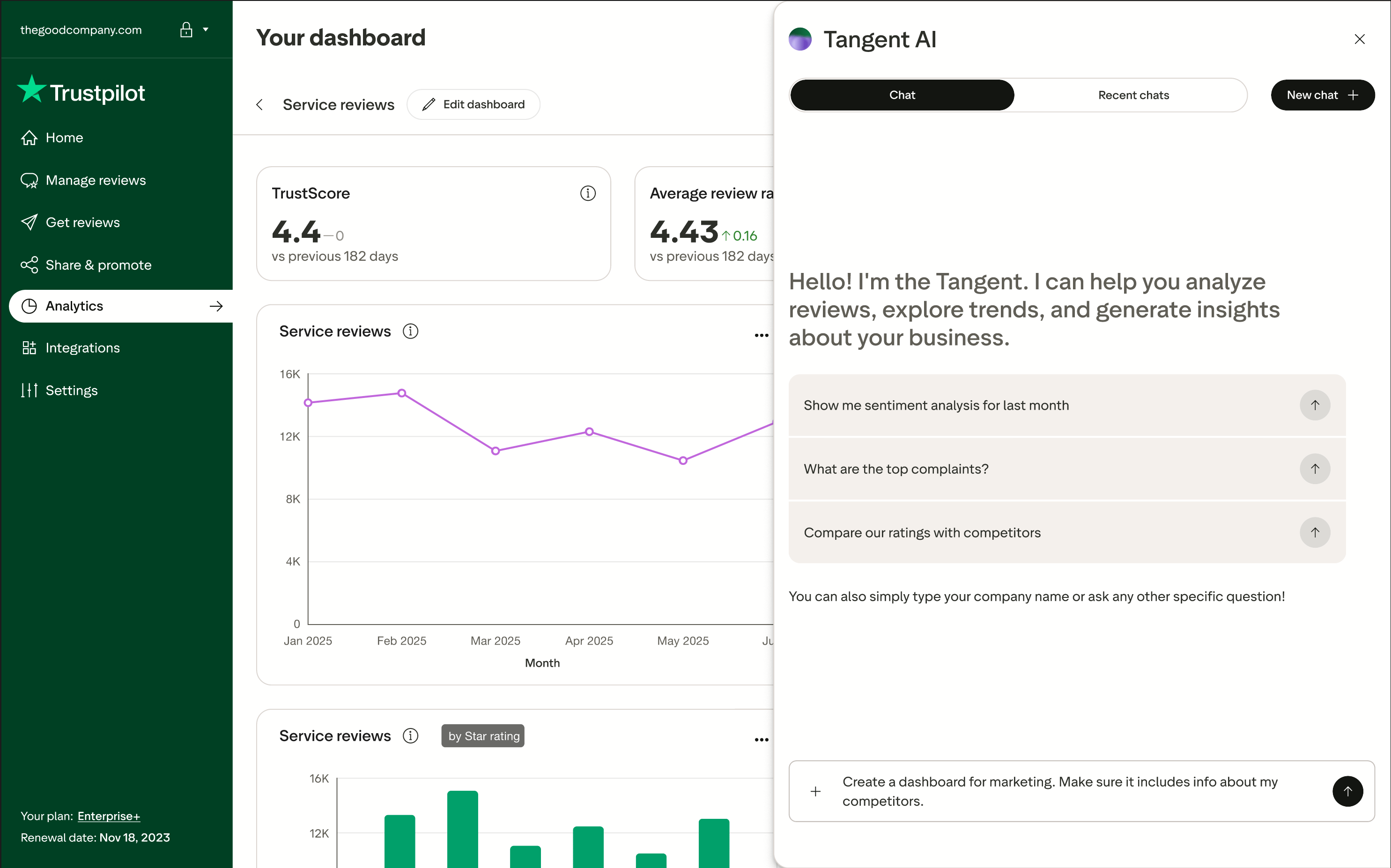
Custom Dashboards is a feature within Trustpilot’s analytics product that lets users move beyond a generic, fixed view of their data. It gives businesses the ability to curate their own analytics experience, selecting the metrics that matter to their role, and sharing polished outputs with internal stakeholders, turning Trustpilot from a review management tool into a strategic insight platform.
Context
Trustpilot's analytics dashboard offered the same rigid, one-size-fits-all view to every user regardless of their role, goals, or reporting workflow. Users were extracting data manually, relying on screenshots, spreadsheets, and third-party tools like HubSpot and Power BI to compile reports. The platform was presenting data, not insight.
My Role
I led the vision, defined the UX direction, and helped translate strategy into modular design systems. I worked cross-functionally to synthesise user needs, align stakeholders, and shape how analytics would scale across the platform.
Synthesised user needs via interviews, workshop artefacts, and jobs-to-be-done
Defined the design hypothesis, north star goals, and HMW opportunity statements
Led the kick-off workshop to align stakeholders around a shared direction
Mapped the end-to-end user journey from awareness through to adoption
Owned the translation of strategy into early concepts and experience principles
The challenge
Delivering Custom Dashboards required navigating a set of organisational and technical tensions that shaped every design decision. The challenge was more than just designing a better dashboard. It was doing so within a platform that had real constraints, a diverse and fragmented user base, and significant cross-functional complexity.
Fragmented user base
Users ranged from daily power users to occasional visitors, spanning very different roles and reporting needs making it difficult to design a single experience that felt genuinely relevant to all of them.
Flexibility vs. simplicity
Users wanted control over their dashboard, but too much configurability risked overwhelming them. Striking the right balance between being tailored enough to feel personal and simple enough to adopt quickly was a constant tension throughout the project.
Data feasibility constraints
Several user needs, such as deeper competitor benchmarking and advanced sentiment segmentation, pushed against the boundaries of what Trustpilot's data could currently support requiring frequent trade-offs between UX ambition and technical feasibility.
Cross-functional alignment
With Product, Engineering, Design, and CX all involved, building shared understanding of priorities was non-trivial. Getting the right people aligned around a single direction required careful facilitation and structured communication at every stage.
Approach
The design process was grounded in what we heard during discovery. Rather than jumping straight to solutions, we used research synthesis to build a shared problem space– mapping user goals, surfacing pain points, and identifying the opportunities most worth pursuing. From there, we developed a design hypothesis that gave the team a clear, testable north star to design towards.
If we offer a customisable dashboard experience where users can shape what they see, how they see it, and how they share it they will be more likely to extract valuable insights, use Trustpilot as a strategic tool, and reduce reliance on manual exports or third-party tools.
Design
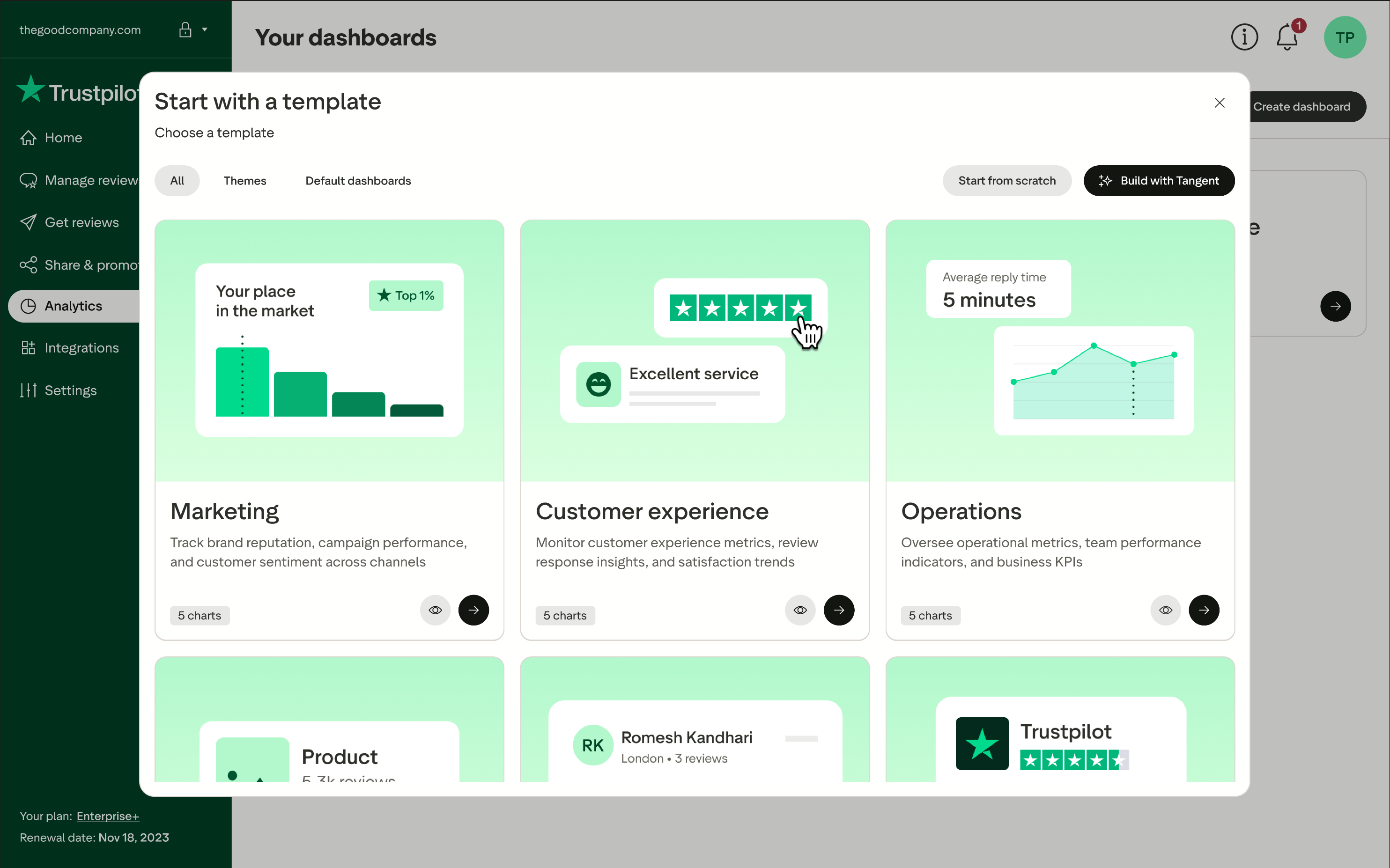
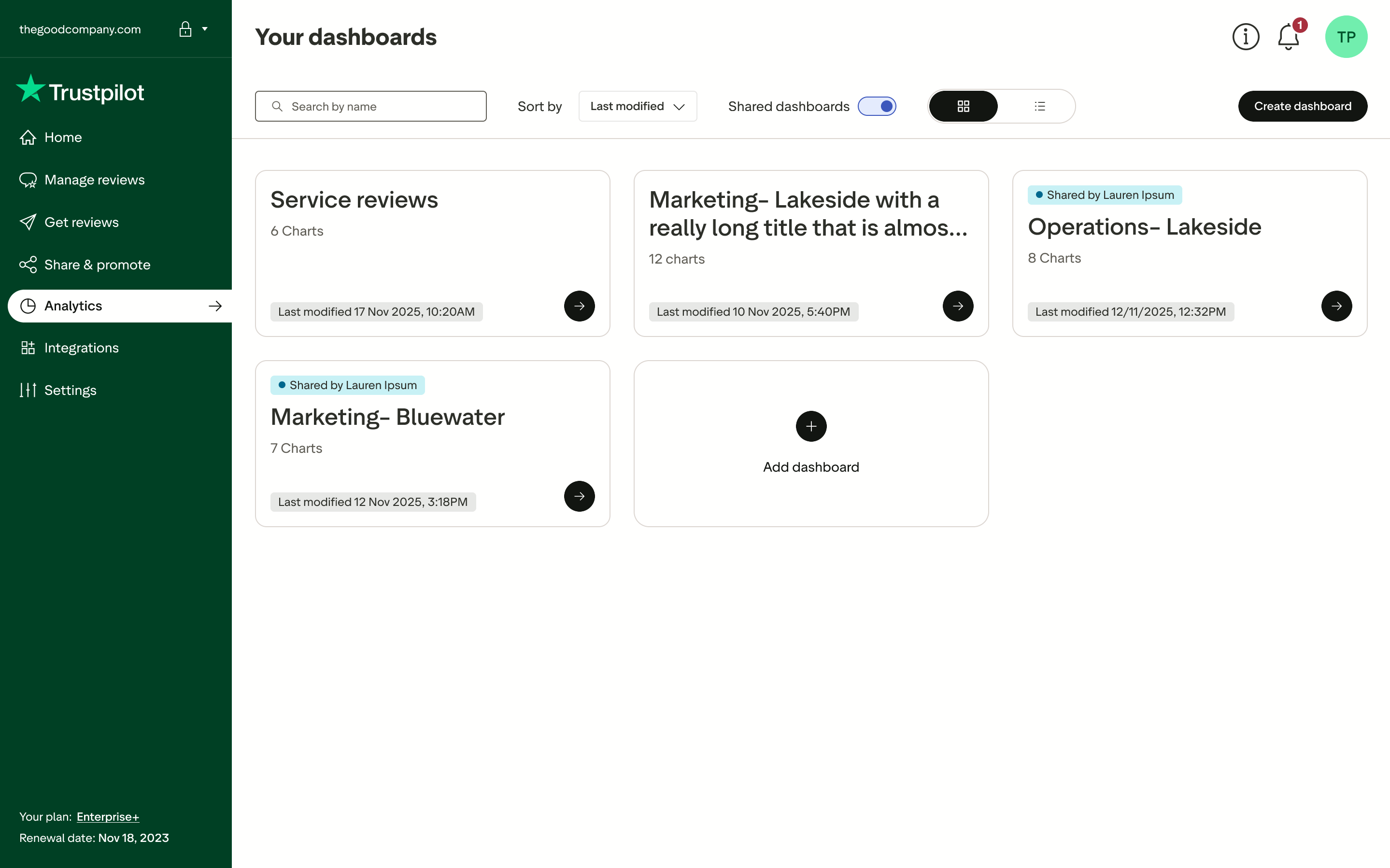
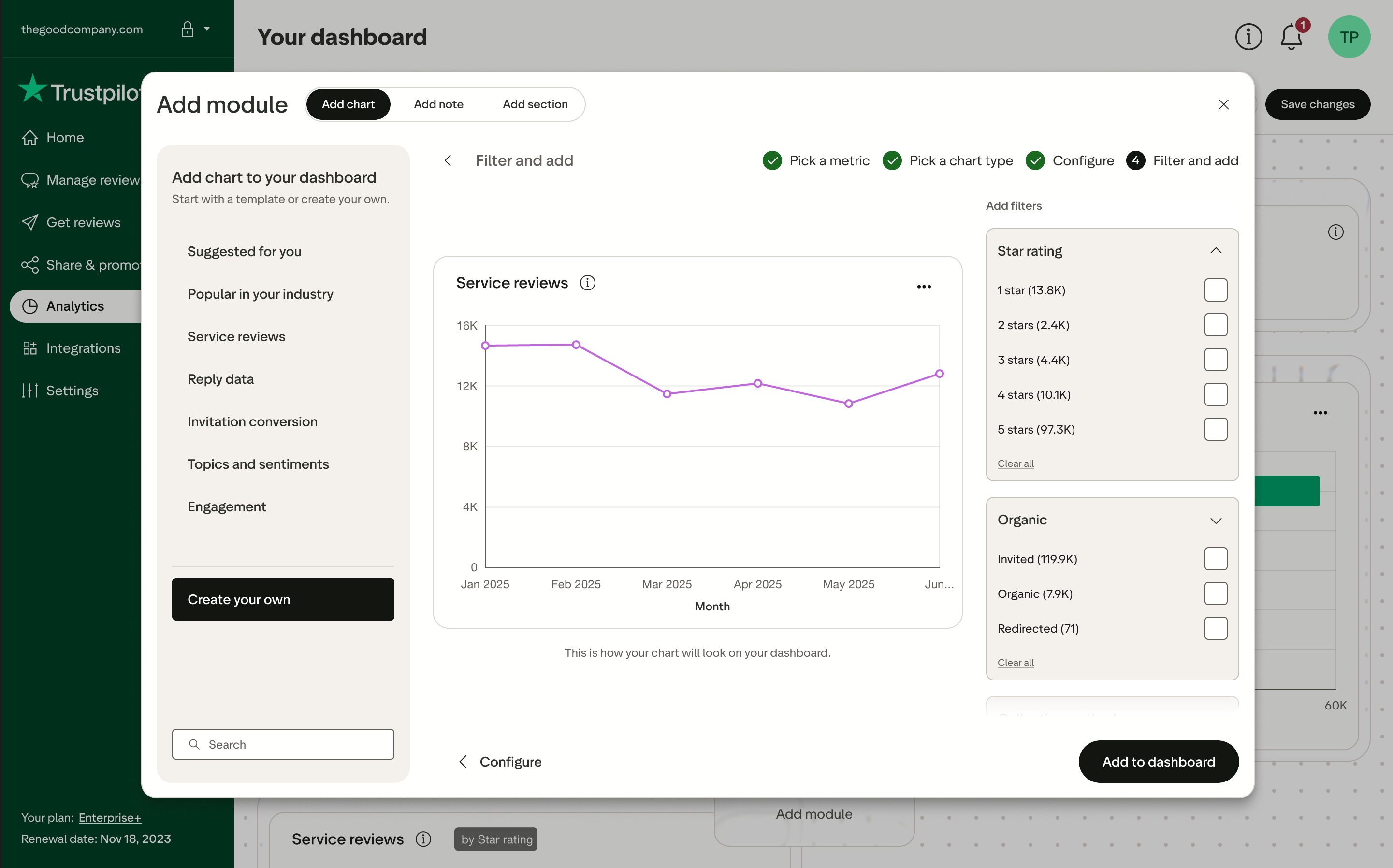
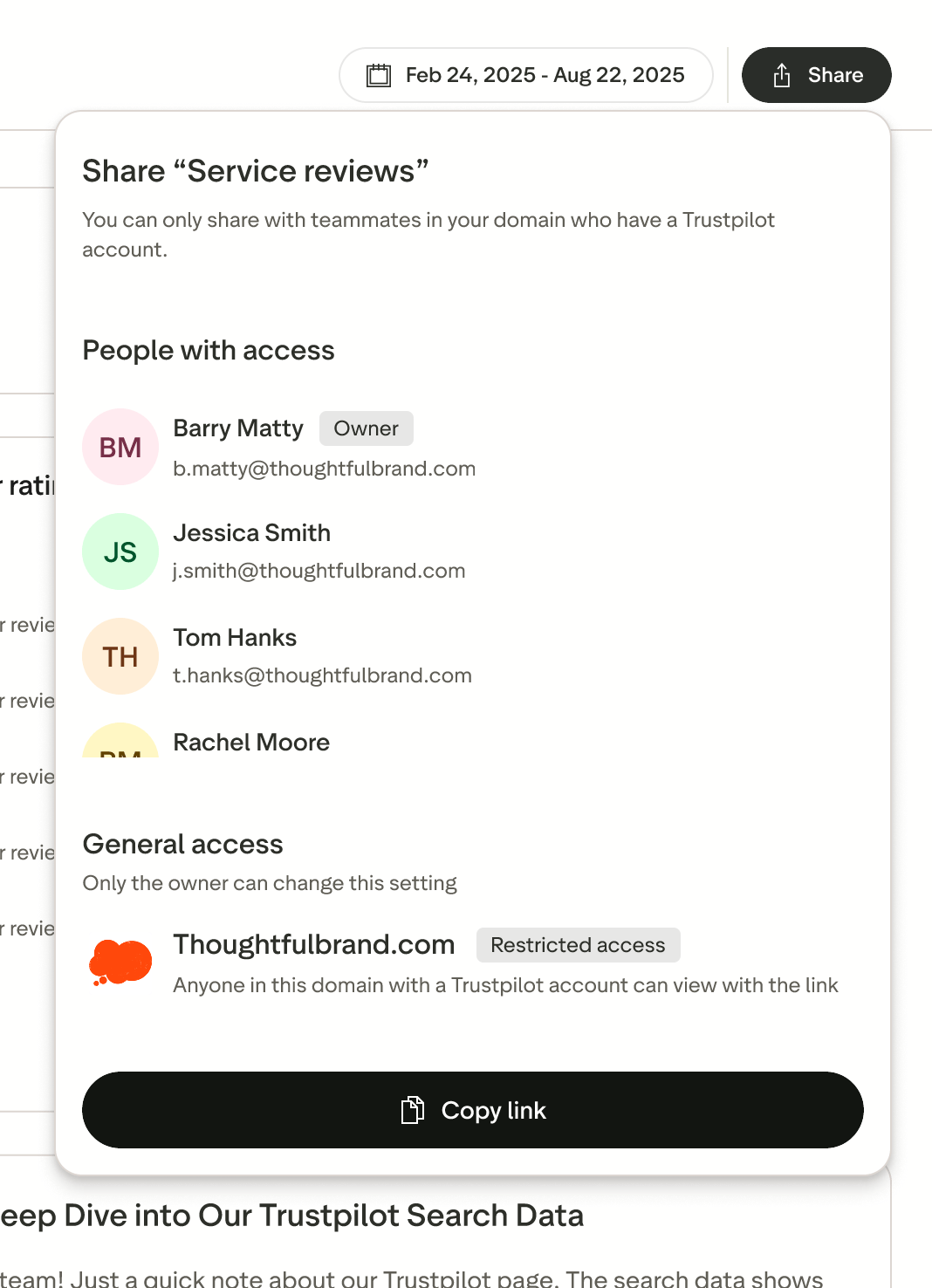
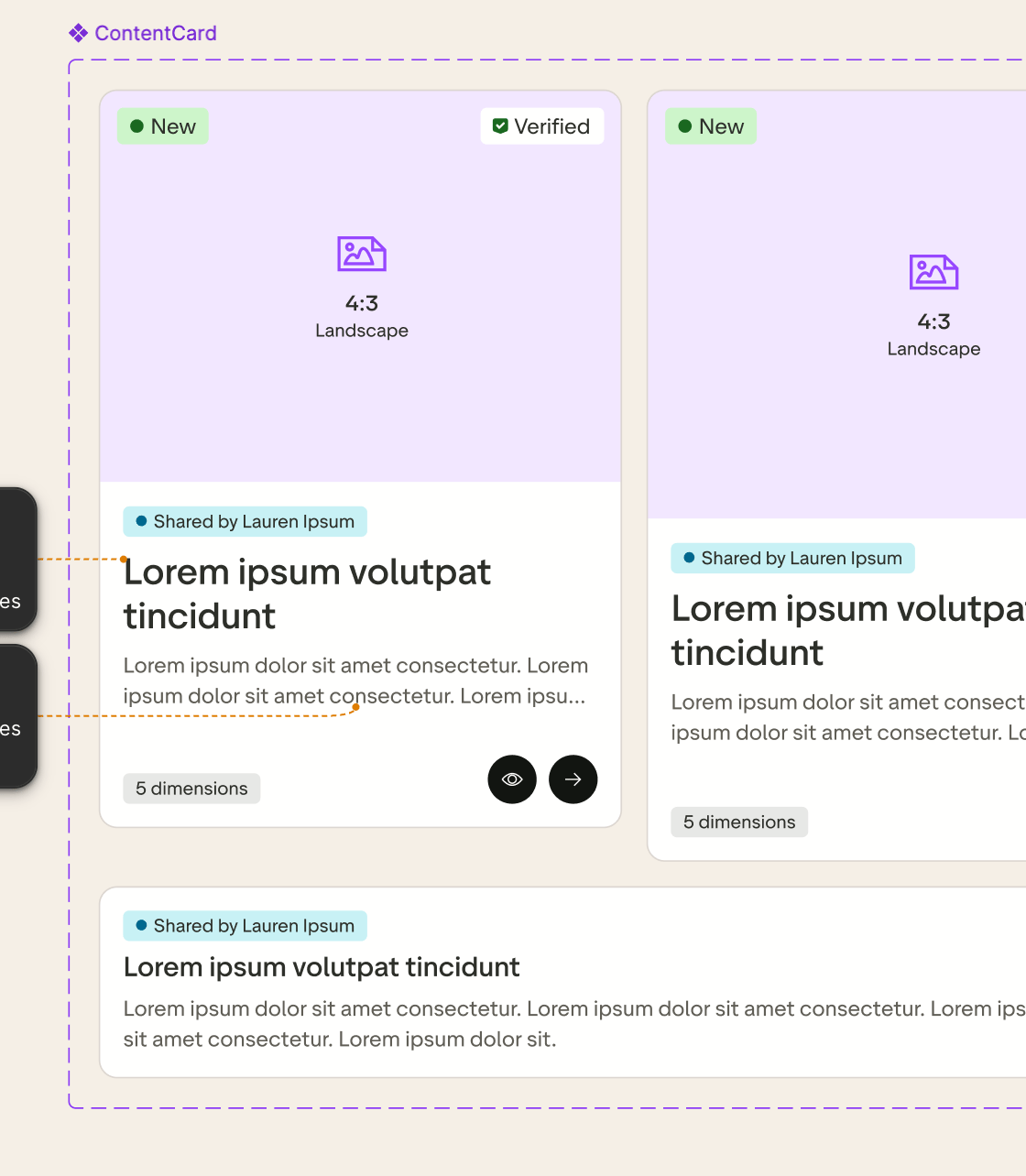
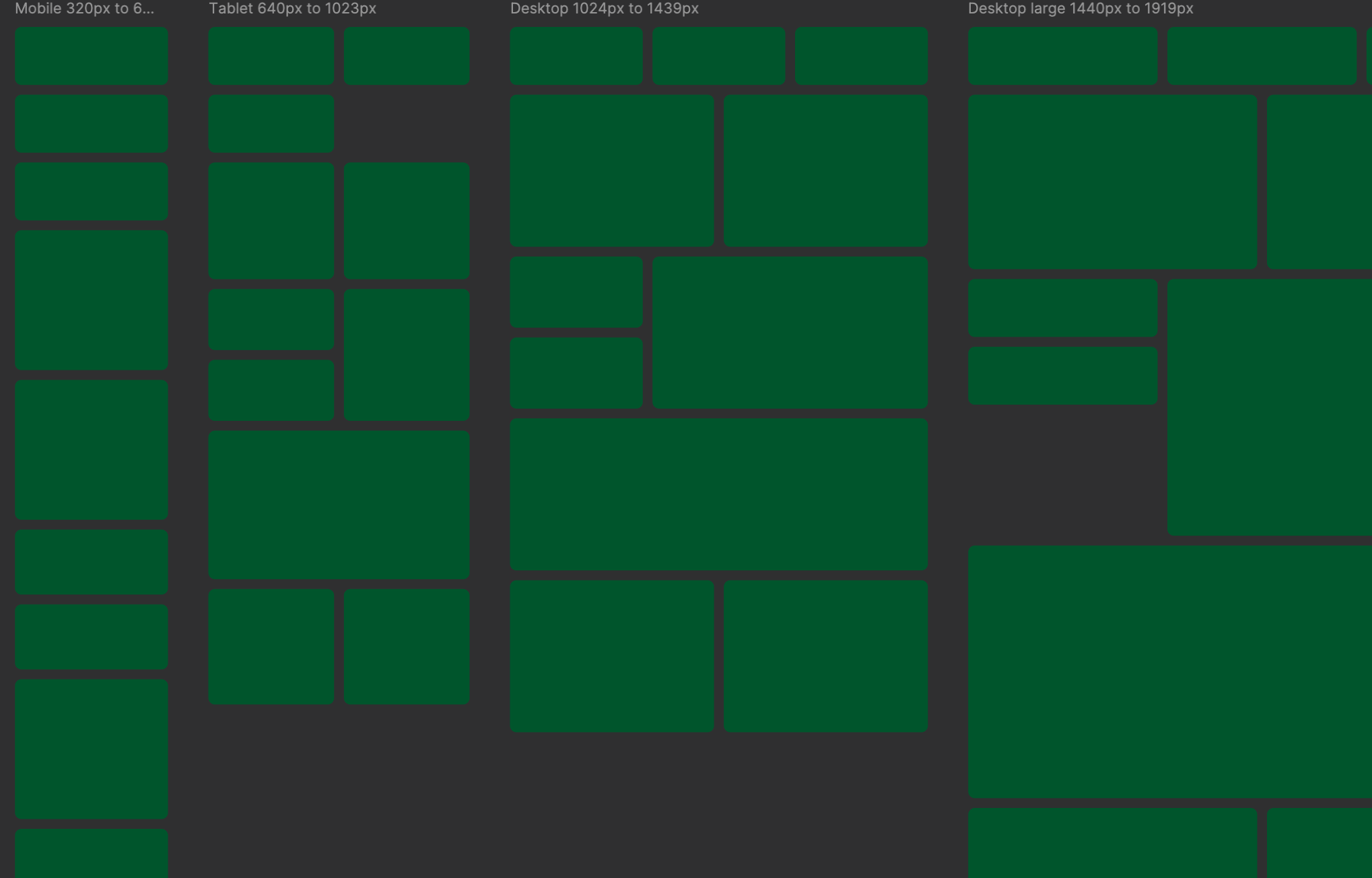
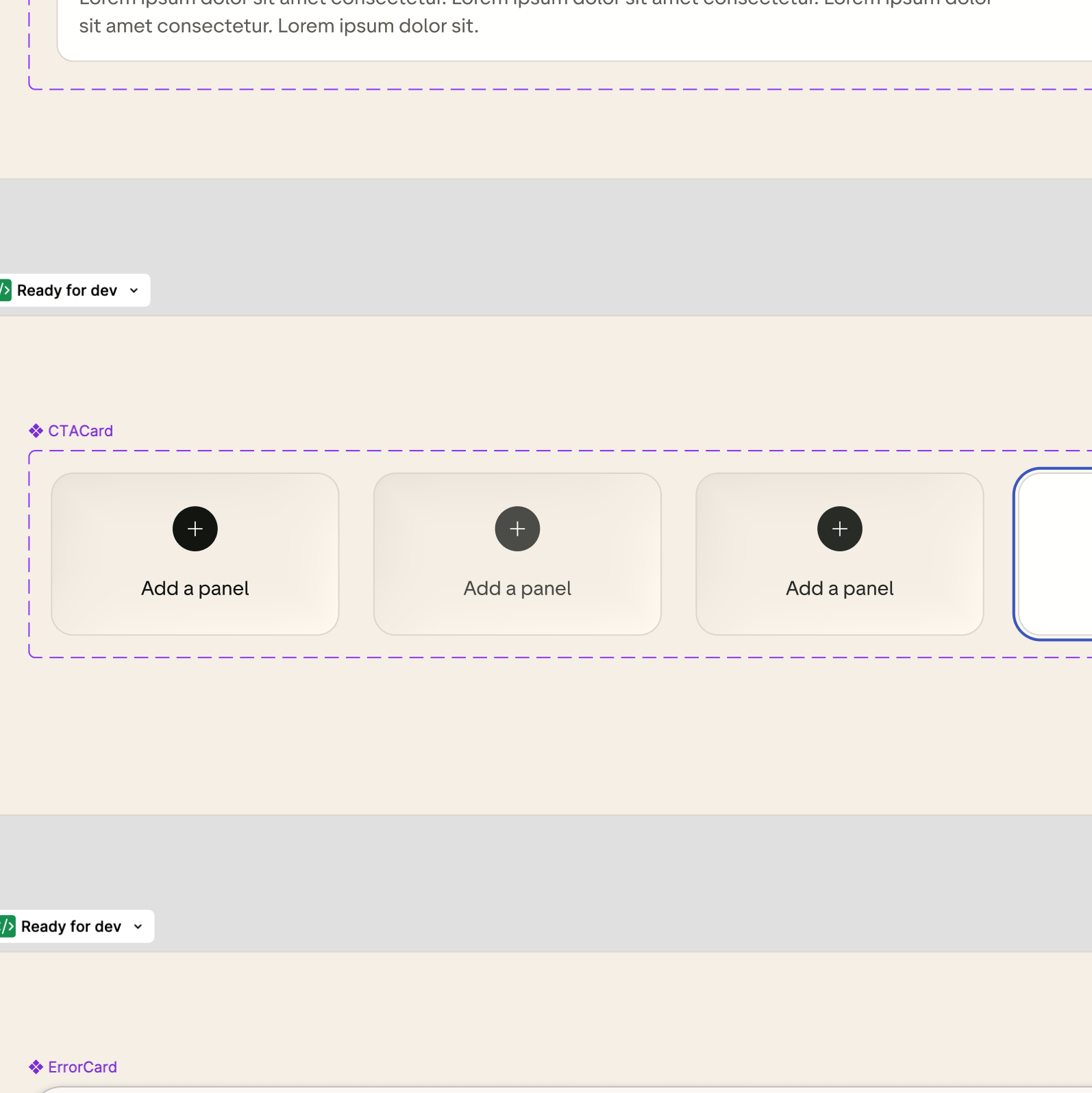
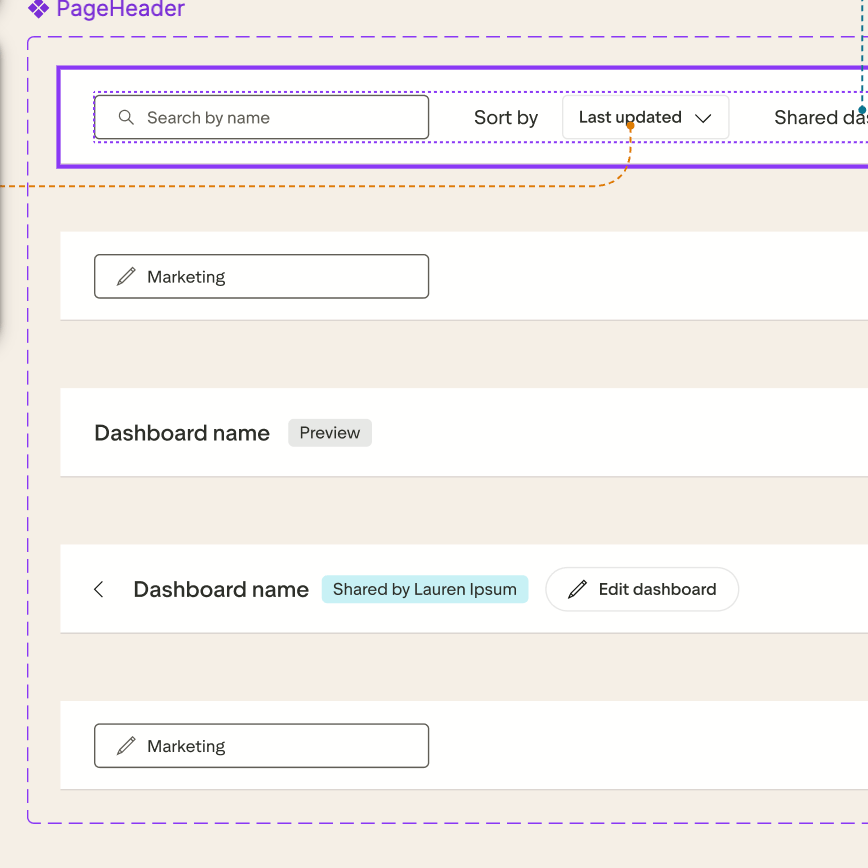
The design centred on giving users a flexible, role-relevant view of their data without adding cognitive load. A modular layout let users curate their own experience. Choosing metrics, organising their view, and exporting outputs that were genuinely stakeholder-ready. The system was designed to work for both novice users getting started with a template and more advanced users building from scratch, while maintaining consistency across Trustpilot's wider analytics ecosystem.
A modular, role-based layout that users could configure to their own workflow
Template-driven onboarding that reduced time-to-value for new users
Exportable, stakeholder-ready outputs built directly into the dashboard experience
A metric discovery layer surfacing data points users didn't know were available
Consistent visual patterns that unified Custom Dashboards within the broader analytics product
Design principles
At the heart of this project were a few core beliefs. They shaped every decision, from layout to interaction.
Clarity over complexity
Data is only useful if it is understood. We stripped back the noise, used consistent visual language, and let the story emerge through structure, not spectacle.

Role relevance over completeness
Not every metric needs to be visible to every user. The right information for the right person, at the right time, is more valuable than a comprehensive view nobody can navigate.

Flexibility without friction
Customisation should feel empowering, not effortful. Every configuration choice was designed to be intuitive enough that users wouldn't need guidance to make it.

Insight over information
The dashboard's job is to help users understand what the data means and what to do next. Design decisions consistently prioritised analysis over raw output.
Impact
Shipped to enterprise and mid-market users following a structured discovery and design process in Q1 2026
Laid the foundation for Agentic tooling
Aligned a cross-functional team of Product, Engineering, Design, and CX around a single, research-backed direction
Established a scalable design foundation for future iterations of Trustpilot's analytics experience
Where clarity begins, momentum follows.
This project was as much about restoring signal where there was noise as it was about redesigning a dashboard. Users weren’t lacking data, they were lacking a way to make it mean something. By designing an experience that adapts to the person using it, we created space for businesses to pause, see patterns, and act with confidence. Custom Dashboards set out to make analytics feel less like a reporting obligation and more like a strategic advantage– legible, flexible, and built around the way people actually work.
Trustpilot
2025, 2026
AI assisted custom dashboards
Trustpilot is a global reviews platform that helps people and businesses build trust. While most people know Trustpilot for its consumer-facing review site, there’s a robust B2B product behind the scenes designed to help businesses collect, analyse, and act on their review data.
Custom Dashboards is a feature within Trustpilot’s analytics product that lets users move beyond a generic, fixed view of their data. It gives businesses the ability to curate their own analytics experience, selecting the metrics that matter to their role, and sharing polished outputs with internal stakeholders, turning Trustpilot from a review management tool into a strategic insight platform.
Context
Trustpilot's analytics dashboard offered the same rigid, one-size-fits-all view to every user regardless of their role, goals, or reporting workflow. Users were extracting data manually, relying on screenshots, spreadsheets, and third-party tools like HubSpot and Power BI to compile reports. The platform was presenting data, not insight.
My Role
As the lead designer on this project, I owned the end-to-end UX process from discovery through to strategic framing. This included planning and conducting user research, synthesising findings into actionable insights, facilitating stakeholder alignment, and defining the design direction for a new customisable analytics experience within Trustpilot's B2B product.
Synthesised user needs via interviews, workshop artefacts, and jobs-to-be-done
Defined the design hypothesis, north star goals, and HMW opportunity statements
Led the kick-off workshop to align stakeholders around a shared direction
Mapped the end-to-end user journey from awareness through to adoption
Owned the translation of strategy into early concepts and experience principles
The challenge
Delivering Custom Dashboards required navigating a set of organisational and technical tensions that shaped every design decision. The challenge was more than just designing a better dashboard. It was doing so within a platform that had real constraints, a diverse and fragmented user base, and significant cross-functional complexity.
Fragmented user base
Users ranged from daily power users to occasional visitors, spanning very different roles and reporting needs making it difficult to design a single experience that felt genuinely relevant to all of them.
Flexibility vs. simplicity
Users wanted control over their dashboard, but too much configurability risked overwhelming them. Striking the right balance between being tailored enough to feel personal and simple enough to adopt quickly was a constant tension throughout the project.
Data feasibility constraints
Several user needs, such as deeper competitor benchmarking and advanced sentiment segmentation, pushed against the boundaries of what Trustpilot's data could currently support requiring frequent trade-offs between UX ambition and technical feasibility.
Cross-functional alignment
With Product, Engineering, Design, and CX all involved, building shared understanding of priorities was non-trivial. Getting the right people aligned around a single direction required careful facilitation and structured communication at every stage.
Approach
The design process was grounded in what we heard during discovery. Rather than jumping straight to solutions, we used research synthesis to build a shared problem space– mapping user goals, surfacing pain points, and identifying the opportunities most worth pursuing. From there, we developed a design hypothesis that gave the team a clear, testable north star to design towards.
If we offer a customisable dashboard experience where users can shape what they see, how they see it, and how they share it they will be more likely to extract valuable insights, use Trustpilot as a strategic tool, and reduce reliance on manual exports or third-party tools.
Design
The design centred on giving users a flexible, role-relevant view of their data without adding cognitive load. A modular layout let users curate their own experience. Choosing metrics, organising their view, and exporting outputs that were genuinely stakeholder-ready. The system was designed to work for both novice users getting started with a template and more advanced users building from scratch, while maintaining consistency across Trustpilot's wider analytics ecosystem.
A modular, role-based layout that users could configure to their own workflow
Template-driven onboarding that reduced time-to-value for new users
Exportable, stakeholder-ready outputs built directly into the dashboard experience
A metric discovery layer surfacing data points users didn't know were available
Consistent visual patterns that unified Custom Dashboards within the broader analytics product
Design principles
At the heart of this project were a few core beliefs. They shaped every decision, from layout to interaction.
Clarity over complexity
Data is only useful if it is understood. We stripped back the noise, used consistent visual language, and let the story emerge through structure, not spectacle.
Role relevance over completeness
Not every metric needs to be visible to every user. The right information for the right person, at the right time, is more valuable than a comprehensive view nobody can navigate.
Flexibility without friction
Customisation should feel empowering, not effortful. Every configuration choice was designed to be intuitive enough that users wouldn't need guidance to make it.
Insight over information
The dashboard's job is to help users understand what the data means and what to do next. Design decisions consistently prioritised analysis over raw output.
Impact
Shipped to enterprise and mid-market users following a structured discovery and design process in Q1 2026
Laid the foundation for Agentic tooling
Aligned a cross-functional team of Product, Engineering, Design, and CX around a single, research-backed direction
Established a scalable design foundation for future iterations of Trustpilot's analytics experience
Where clarity begins, momentum follows.
This project was as much about restoring signal where there was noise as it was about redesigning a dashboard. Users weren’t lacking data, they were lacking a way to make it mean something. By designing an experience that adapts to the person using it, we created space for businesses to pause, see patterns, and act with confidence. Custom Dashboards set out to make analytics feel less like a reporting obligation and more like a strategic advantage– legible, flexible, and built around the way people actually work.
Trustpilot
2025, 2026
AI assisted custom dashboards
Trustpilot is a global reviews platform that helps people and businesses build trust. While most people know Trustpilot for its consumer-facing review site, there’s a robust B2B product behind the scenes designed to help businesses collect, analyse, and act on their review data.
Custom Dashboards is a feature within Trustpilot’s analytics product that lets users move beyond a generic, fixed view of their data. It gives businesses the ability to curate their own analytics experience, selecting the metrics that matter to their role, and sharing polished outputs with internal stakeholders, turning Trustpilot from a review management tool into a strategic insight platform.
Context
Trustpilot's analytics dashboard offered the same rigid, one-size-fits-all view to every user regardless of their role, goals, or reporting workflow. Users were extracting data manually, relying on screenshots, spreadsheets, and third-party tools like HubSpot and Power BI to compile reports. The platform was presenting data, not insight.
My Role
I led the vision, defined the UX direction, and helped translate strategy into modular design systems. I worked cross-functionally to synthesise user needs, align stakeholders, and shape how analytics would scale across the platform.
Synthesised user needs via interviews, workshop artefacts, and jobs-to-be-done
Defined the design hypothesis, north star goals, and HMW opportunity statements
Led the kick-off workshop to align stakeholders around a shared direction
Mapped the end-to-end user journey from awareness through to adoption
Owned the translation of strategy into early concepts and experience principles
The challenge
Delivering Custom Dashboards required navigating a set of organisational and technical tensions that shaped every design decision. The challenge was more than just designing a better dashboard. It was doing so within a platform that had real constraints, a diverse and fragmented user base, and significant cross-functional complexity.
Fragmented user base
Users ranged from daily power users to occasional visitors, spanning very different roles and reporting needs making it difficult to design a single experience that felt genuinely relevant to all of them.
Flexibility vs. simplicity
Users wanted control over their dashboard, but too much configurability risked overwhelming them. Striking the right balance between being tailored enough to feel personal and simple enough to adopt quickly was a constant tension throughout the project.
Data feasibility constraints
Several user needs, such as deeper competitor benchmarking and advanced sentiment segmentation, pushed against the boundaries of what Trustpilot's data could currently support requiring frequent trade-offs between UX ambition and technical feasibility.
Cross-functional alignment
With Product, Engineering, Design, and CX all involved, building shared understanding of priorities was non-trivial. Getting the right people aligned around a single direction required careful facilitation and structured communication at every stage.
Approach
The design process was grounded in what we heard during discovery. Rather than jumping straight to solutions, we used research synthesis to build a shared problem space– mapping user goals, surfacing pain points, and identifying the opportunities most worth pursuing. From there, we developed a design hypothesis that gave the team a clear, testable north star to design towards.
If we offer a customisable dashboard experience where users can shape what they see, how they see it, and how they share it they will be more likely to extract valuable insights, use Trustpilot as a strategic tool, and reduce reliance on manual exports or third-party tools.
Design
The design centred on giving users a flexible, role-relevant view of their data without adding cognitive load. A modular layout let users curate their own experience. Choosing metrics, organising their view, and exporting outputs that were genuinely stakeholder-ready. The system was designed to work for both novice users getting started with a template and more advanced users building from scratch, while maintaining consistency across Trustpilot's wider analytics ecosystem.
A modular, role-based layout that users could configure to their own workflow
Template-driven onboarding that reduced time-to-value for new users
Exportable, stakeholder-ready outputs built directly into the dashboard experience
A metric discovery layer surfacing data points users didn't know were available
Consistent visual patterns that unified Custom Dashboards within the broader analytics product
Design principles
At the heart of this project were a few core beliefs. They shaped every decision, from layout to interaction.
Clarity over complexity
Data is only useful if it is understood. We stripped back the noise, used consistent visual language, and let the story emerge through structure, not spectacle.
Role relevance over completeness
Not every metric needs to be visible to every user. The right information for the right person, at the right time, is more valuable than a comprehensive view nobody can navigate.
Flexibility without friction
Customisation should feel empowering, not effortful. Every configuration choice was designed to be intuitive enough that users wouldn't need guidance to make it.
Insight over information
The dashboard's job is to help users understand what the data means and what to do next. Design decisions consistently prioritised analysis over raw output.
Impact
Shipped to enterprise and mid-market users following a structured discovery and design process in Q1 2026
Laid the foundation for Agentic tooling
Aligned a cross-functional team of Product, Engineering, Design, and CX around a single, research-backed direction
Established a scalable design foundation for future iterations of Trustpilot's analytics experience
Where clarity begins, momentum follows.
This project was as much about restoring signal where there was noise as it was about redesigning a dashboard. Users weren’t lacking data, they were lacking a way to make it mean something. By designing an experience that adapts to the person using it, we created space for businesses to pause, see patterns, and act with confidence. Custom Dashboards set out to make analytics feel less like a reporting obligation and more like a strategic advantage– legible, flexible, and built around the way people actually work.